Great Friday & Saturday of the Light of Great Lent
Bishop Gregory Mansour explains these Profound Lenten Mysteries on Zoom presented by the Eparchial Couples Ministry and Saint Sharbel Spiritual Life Center on April 1, 2025
Great Friday & Saturday of the Light of Great Lent
Bishop Gregory Mansour explains these Profound Lenten Mysteries on Zoom presented by the Eparchial Couples Ministry and Saint Sharbel Spiritual Life Center on April 1, 2025

|
|
|

Maronite History Workshop at 8pm on Thursday's
February 6: St. Maron and Maronite Liturgy (Fr. Dominque Hanna)
February 13: Maronite Music and Melodies (Fr. Neemtallah Odissey)
February 20: Maronites & the Holy See (Chorbishop John Faris)
Hosted by the Maronite Servants of Christ the Light in conjunction with the Saint Sharbel Spiritual Life Center.
Introduction to Syriac Spirituality 
Father Claude Franklin, pastor of St. Joseph Maronite Church in Olean NY takes us on a tour of our inspiring and prayerful rituals of Great Lent. Take some time to view them for your own spiritual formation. The workshops will deepen your celebration of these holy days. Thank you, Father Claude!
stmaron.org/pastoral-letters (Bishop Gregory’s Pastoral Letters)
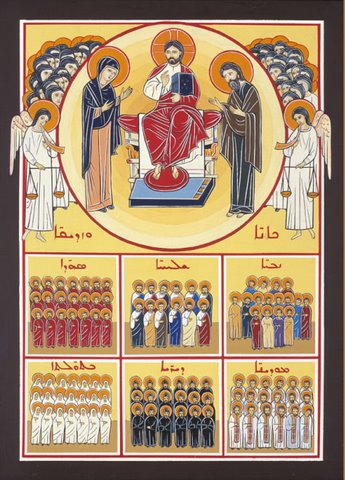
Commemorations in the Maronite Liturgical Year
Christmas Novena Prayers (click here)
By Living Maronite
Maronite Christmas Novena, begins on 15 December and is nine consecutive days of prayer. It is a wonderful way of preparing ourselves for the birth of our Lord.
The Novena is designed to be prayed as a Parish community and includes incensing of the Blessed Sacrament, prayers, Syriac hymns and ends with Benediction of the blessed sacrament.
However, we have adapted a version on this podcast for families who can’t make it to a Church to participate at home for 9 days. It follows the inter-eparchial English format below and only requires 15 minutes per day. The text can be found at the link below and of course the podcast can’t include the benediction.

By Fr. Claude W. Franklin, Jr., S.E.O.L
Around this time every year our parishes begin anew their Sunday School programs, and we celebrate “Catechetical Sunday”; this year on 20 September. But what exactly is “Catechesis?” Is it only done in Sunday School classrooms?
“Catechesis” comes from the Greek word katakeesis, meaning: “oral instruction” or more generally “instruction.” Thus, the one receiving “instruction” is known as a “catechumen” and the “instructor” is his or her “catechist.”
In a technical sense, the “Catechumenate” is a program for those coming into the faith, who have not yet been Baptized, nor received the Mysteries of Chrismation or the Eucharist. But we often use the term in a broader sense, such as the “Catechism of the Catholic Church.” In this case, we are referring to a document of the Catholic Church intended to “instruct” the Catholic faithful in the teachings of the Catholic Church.
The Hoosoyo is comprised of a Proemion, Sedro, Qolo and ‘Etro. A Proemion (Greek: “preface” or “introduction”), is typically an introduction to the commemoration being celebrated, and invokes the Trinity, for example: “Let us raise glory, honor, and praise to
the One Father, Whose voice came from Heaven testifying to His Beloved Son; and to the Only-Begotten Son, Who is worshipped, Whose light radiated upon the river, and Who accepted Baptism from John, His Forerunner; and the One Holy Spirit, Who descended and appeared above the head of the Son. To the Good One be glory and honor, on this Feast, and all the days of our lives, and forever. Amen.” (Feast of Epiphany, Book of Offering, 110)
Notice how this “introduction” sums up the Feast of Epiphany (Greek word meaning: “manifestation” or “appearance”) in terms of how each of the Persons of the Trinity “manifested” themselves on this day. However, the Proemion also reminds us that the Most Holy Trinity is “One” – “One Father,” “Only-Begotten,” “One Holy Spirit” – for the prayer ends by sending up “glory and honor” to the “Good One”!
This is followed by a Sedro (Syriac: “list” or “order”). This term refers to the fact that the second half of the Sedro prayer is a “list” of petitions, for example: “strengthen the weak, heal the sick, and satisfy the hungry...” (Feast of Sts. Peter and Paul, Book of Offering, 567). The first half of the Sedro is often the teaching portion, in which we are reminded of what or who we are commemorating, which leads into the second half, in which we ask either the Lord directly, or the saint being commemorated, to intercede to the Lord on our behalf with our “list” of petitions.
The next element which we find in a Hoosoyo is a Qolo (Syriac: “voice” or “hymn”). The tunes used for the Qolo of the Hoosoyo varies, but it will often mention the burning of incense, for example: “Alleluia! Aaron offered incense to Almighty God pleading with Him to avert death from the plague. With the fragrant incense that we offer now, may God spare us from the sting of sin and death.” (Thursday B of the Season of Pentecost, Book of Offering, 536) Note first the connection here between the incense of Aaron and our incense – as God did in the past, so too we ask Him to do for us now. But notice that the second half of this Stanza develops this theme. We remind the Lord that the incense offered in the past helped God’s People (the Jews) “avert death from the plague” (cf. Numbers 16:46-48), now we ask Him to “spare us from the sting of sin and death.” (cf. 1 Corinthians 15:55-57)
Finally, the Hoosoyo is concluded with an ‘Etro (Syriac: “incense” or “smoke”), also known in many manuscripts as Qubolo (Syriac word meaning: “acceptance”). The ‘Etro, or Qubolo, is a prayer which asks the Lord to “accept” the “incense” we have offered to Him, similar in scope to the Stanza of the Qolo we just saw, except the ‘Etro is expressed in prose, for example: “O Lord, You are the Pleasant Incense and the Sweet Fragrance, and You bless the whole world with Your Divine Gifts. Accept the fragrance of this incense that we have offered to You, and grant mercy to our souls, forgiveness for our sins, and rest to our departed. To You be glory, now and forever. Amen.” (Tuesday B, Season of Pentecost, Book of Offering, 517) Note that here the request for the Lord “to accept” our incense is direct; unlike the Qolo, which has us (and the Lord) remember how the Lord accepted the incense of our ancestors. Also, in this instance, Christ is taking on the terminology of the incense itself: “You are the Pleasant Incense and the Sweet Fragrance.”
We also find this theme of “acceptance” of our incense in Psalm 141:2 “Let my prayer be counted as incense before Thee...” (RSVCE). For in the Syriac view, the incense represents our sins; the burning charcoal is God’s Mercy. Our sins are placed upon God’s Mercy and are transformed from foul-smelling sins to sweet-smelling prayers rising before the Throne of God, which we ask Him to accept, along with our “list” of petitions from the Sedro. This idea of transformation and our role in helping others be transformed is found in 2 Corinthians 2: 15-16: “For we are the aroma of Christ to God among those who are being saved and among those who are perishing, to one a fragrance from death to death, to the other a fragrance from life to life...” (RSVCE)
While the primary function of the Hoosoyo is as a “Prayer of Forgiveness,” it is also a liturgical tool for catechesis. How?
Let us return to the Sedro, especially the first half. The first half of the Sedro has characteristics of an Anamnesis (Greek word meaning: “remembrance” or “commemoration”). It is here that we see the Church “instructing” the faithful about the feast being commemorated. The Church “remembers” and in a sense “reminds” God of what wonders He has done in the past and how the “Righteous and Just” have held onto the Catholic Faith, and in the case of the martyrs, even to the point of shedding blood. The actions of these holy ones teach us in our days to be faithful as our ancestors in the past were, so that we may achieve holiness like them. We already saw an example of this in the Stanza of the Qolo above, but this is often much more developed in the Sedro itself. The first half of the Sedro naturally flows into the second half, which is the “application” of the theme for us and our loved ones, usually with the connecting word of “now.” Much like in a sermon, the preacher will explain how a particular Scripture passage “applies” to our lives, so it is with this “now” portion of the Sedro, that we ask the Lord to “apply” His Mercy and Compassion upon us and fulfill the requests of our “list,” for example:
“O Christ our God, You are the True Light Who has come into the world. You are the Way that leads to the Father, and no one comes to the Father except through You. You showed us Your Love when You lived among us, and You told us of the Father’s Compassion and His Love for repentant sinners. You spoke to us of repentance, of mercy, and of living water. Today we meditate on the Parable of the Prodigal Son, who, trusting his father; turned from his life of corruption and repented of his sin.
Now, O Lord, we ask You, with the fragrance of this incense, to have compassion on us, as you have compassion on all sinners. May we humble ourselves before You and repent of our sins. Enlighten us that we may know You. Strengthen us with Your Power, and do not turn Your Face away from us lest the darkness of sin surround us.
Send Your Spirit to us sinners during this forgiving Season of Lent, so that we may return to You seeking forgiveness. Open Your Blessed Arms to us, and bring us close to You, so that we may meet You with joy and find happiness in knowing You. Be our strength and our help, that we may glorify You, Your Father, and Your Holy Spirit, forever. Amen.” (Sunday of the Prodigal Son, Book of Offering, p 220-221)
This Sedro beautifully demonstrates how the Hoosoyo in general, and the Sedro in particular, is a “tool for liturgical catechesis.” It takes the famous “Parable of the Prodigal Son,” reminds us, and our Lord, of key important aspects of it: “repentance” and how the son “turned from his life of corruption” by “trusting his father” and his “mercy.” In the “now” portion of the Sedro, we are encouraged to do the same as sons and daughters of our Heavenly Father. Like the son in the parable, we must “humble ourselves before You and repent of our sins.” But notice that we cannot do it on our own, we need help, and so we make our “list” and ask our Lord: “with the fragrance of this incense, to have compassion on us.” And to “enlighten us that we may know You. Strengthen us with Your Power, and do not turn Your Face away from us...” Finally, this particular Sedro, in addition to the normal Anamnesis section has an Epiclesis (Greek word meaning:“invocation,” normally an invocation of the Holy Spirit). “Send Your Spirit to us sinners...so that we may return to You seeking forgiveness,” again a reminder to us, that we cannot repent on our own, we need God’s assistance. And we are finally reminded of how the father of the prodigal son (representing the Heavenly Father) reacted to his son’s return: “Open Your Blessed Arms to us, and bring us close to You...”
Hopefully this short explanation of the Hoosoyo has fostered an appreciation of the Hoosoyo as a tool for liturgical catechesis transmitted to us by our spiritual fathers. To learn more about the Hoosoyo, especially a bit about its history and origins read: Amar, Joseph, “The Syriac Hoosoyo: A Consideration of Narrative Techniques,” Diakonia 22/3 (1988-89) 153-168.
Fr. Claude W. Franklin, Jr. is a Maronite Priest of the Eparchy of St. Maron of Brooklyn and in 2005 received a Licentiate Degree in Liturgy from the Pontifical Oriental Institute in Rome.
 Born Youssef Makhlouf in Beqa Kafra on 8 May 1828, he was the fifth child in a family of simple farmers. When he was three years old, his father was taken away by the Ottoman Army, never to return. Youssef was sent to the village school, and as a child was given to prayer. At a young age, he knew that God was calling him to become a monk. He prayed to Our Lady to make it come to pass. Two of his mother’s brothers were already monks. However, he did not leave until 1851, when a woman indicated her desire to marry him. Saying nothing, he left home the next morning to enter the monastery of Our Lady of Mayfouq, which was run by the Lebanese Maronite Order (“the LMO”). However, he was pursued there by his uncle, mother and relatives. They begged him to return home, marry, work and look after them. Charbel refused, saying that God wanted him entirely. It is said that in the end his mother gave her consent, telling him to be a good monk, but if he was going to be mediocre, then he should return home. READ MORE HERE